Computers didn't suddenly become fast, powerful and portable overnight. The devices we use are the results of decades of evolution. To see how far these devices has evolved, we can divide them in terms of generations where each generation represents a major breakthrough in hardware and capabilities. There are currently five generations of computers.
First generation (1940s to 1950s)
 |
| UNIVAC I |
Programming was done using machine language which made it slow and prone to a lot of errors. And for memory, magnetic drums were used while punch cards were used for input/output.
Eg: ENIVAC, UNIVAC I
Second generation (1950s to 1960s)
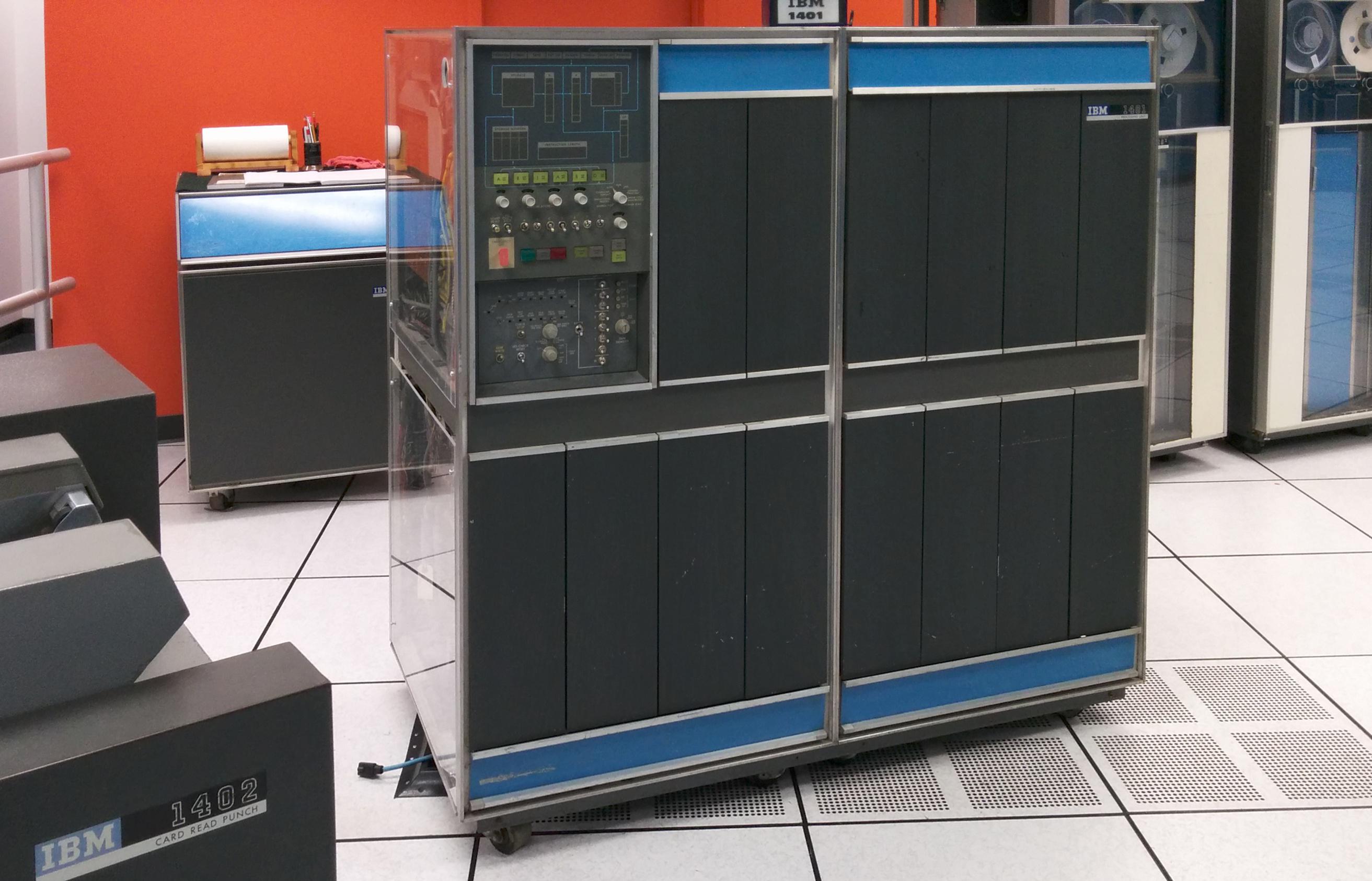 |
| IBM 1401 |
The second generation of computers started as people started replacing vacuum tubes with transistors, which was a massive improvement. Compared to first generation computers, these were smaller in size, faster, more reliable, produced less heat and used less energy.
Assembly language and early high level programming languages like FORTRAN and COBOL were introduced in this era, making programming more simple. And Magnetic core memory was used for storage, which was faster and more reliable than previous methods.
During this era, computers became more accessible for scientific, business and government usage.
Eg: IBM 1401, IBM 7094
Third generation (1960s to 1970s)The third generation introduced integrated circuits (ICs), which combined multiple transistors into one chip. This was a massive improvement in technology, leading to computers becoming much smaller in size. Computers become less expensive but more reliable than third generation devices. And the processing speed became faster and faster.
Operating systems became more advanced as multiprogramming was introduced, allowing computers to run multiple programs at once. Keyboards and monitors also became common in this era.
This shift to ICs from transistors made computers more accesible, enabling widespread use in education , small businesses and scientific analysis.
Eg: IBM System/360, PDP-8
The forth generation is defined by the introduction of microprocessors, where an entire CPU can be fitted into one single chip. This new invention dramatically reduced the size, cost and power consumption compared to early generations. And devices became faster, powerful and more affordable.
During this era, computers became more accessible for scientific, business and government usage.
Eg: IBM 1401, IBM 7094
| IBM System/360 |
Operating systems became more advanced as multiprogramming was introduced, allowing computers to run multiple programs at once. Keyboards and monitors also became common in this era.
This shift to ICs from transistors made computers more accesible, enabling widespread use in education , small businesses and scientific analysis.
Eg: IBM System/360, PDP-8
Forth generation (1970s - Present)
| Apple II |
The forth generation is defined by the introduction of microprocessors, where an entire CPU can be fitted into one single chip. This new invention dramatically reduced the size, cost and power consumption compared to early generations. And devices became faster, powerful and more affordable.
This led to the rising of personal computers (PCs) being used. Graphical user interfaces (GUIs) were introduced in this era, making computers accessible to not just large organizations but everyone in the world. This generation also saw the growth of the internet, software applications and consumer electronics.
Eg: Apple II, IBM PC
While fully intelligent computers are still a work in progress, technologies like machine learning, voice assistants and automation are already a part of everyday life.
This generation represents the future direction of computing rather than a fully completed stage.
Eg: Apple II, IBM PC
Fifth Generation (Present - )
Instead of focusing on how to make devices smaller in size and less costly, this generation focuses on how to make machines more intelligent. Natural language processing, Robotics, Machines that can learn and reason, Parallel processing and Quantum computing are some of the main focuses.While fully intelligent computers are still a work in progress, technologies like machine learning, voice assistants and automation are already a part of everyday life.
This generation represents the future direction of computing rather than a fully completed stage.
Comments
Post a Comment